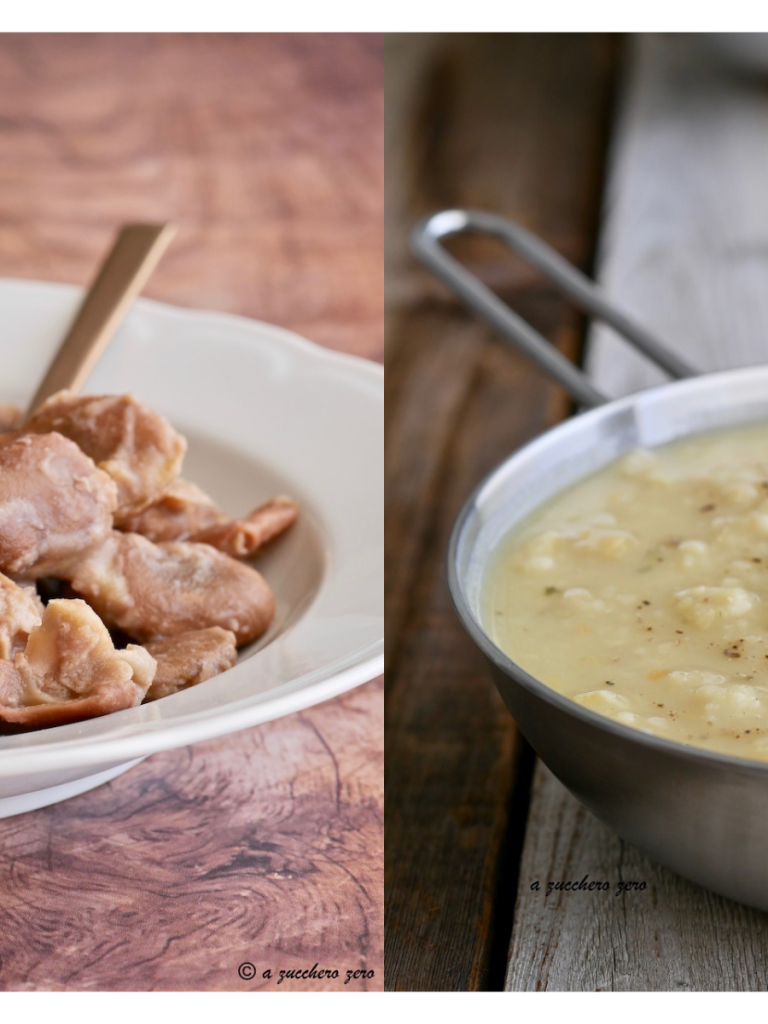
My basic recipe for cooking dried fava beans perfect as a soup or as a base for appetizers, first or second courses.
I prefer dried fava beans with their skin because they are richer in fiber.
The skins can be removed after cooking but, given their high fiber content, if well tolerated it is recommended to leave them on.
If you need to reduce fiber, shelled fava beans are the alternative to whole beans with skin.
Soaking
Remember that dried legumes need to soak for 12-24 hours, during which it is good to change the water a couple of times and then rinse them well before cooking.
Choosing the fava beans
I prefer to buy locally sourced fava beans: Modica or Leonforte.
Cooking in a pressure cooker or in a regular pot.
You may also be interested in:
- Difficulty: Easy
- Cost: Low cost
- Rest time: 12 Hours
- Preparation time: 20 Minutes
- Cooking time: 20 Minutes
- Portions: 2Servings
- Cooking methods: Pressure cooker, Stovetop
- Cuisine: Italian
Ingredients
- dried fava beans (with skin or shelled, 2 servings, weight according to your dietary plan)
- as needed water (equal to twice the volume of the fava beans)
- as needed salt
- 1 drizzle extra virgin olive oil (to be added raw)
I usually prepare extra portions to have a convenient supply to freeze [meal prep].
Do not overfill with ingredients – fava beans produce foam and can cause boil-overs.
Suggested tools
- 1 Fine-mesh strainer fine mesh
- 1 Bowl or salad bowl
- Pressure cooker
Preparation
Spread the fava beans on a work surface and check them carefully, removing any impurities or small stones.
Soaking makes the fava beans soft and helps release anti-nutritional substances into the water.
The soaking water should not be used for cooking.– Wash and rinse the dried fava beans well until the water runs clear;
– Soak them for about 12 hours, changing the water a couple of times;
– Rinse the rehydrated fava beans well before cooking.Waste-saving tip
Use a fine-mesh strainer or fuscelle [the perforated baskets used for fresh ricotta] to drain the legumes and collect the soaking water to water plants; do not use it for food.The rehydrated and cleaned fava beans are ready to be put in the pot.
Fava beans with the skin
Using a knife, remove the top part of the bean called the “eye” or “nasello” [the black scar].Before you begin
– Always consult the manual of your pressure cooker;
– Check that valves and seals are clean;
– Do not exceed the maximum fill line indicated inside the pot.In the pressure cooker, add:
– the fava beans;
– water equal to twice the volume of the fava beans.
Close the pot.
Always make sure the gasket is correctly positioned and the valve is free.
Bring to a boil over medium-high heat until the pot reaches pressure and the valve emits the classic whistle.
Once at pressure, reduce the heat and cook for about 10 minutes.
Turn off the heat, allow the steam to release completely, then open the lid carefully and away from your face.
Add salt now and not at the start of cooking to avoid hardening the outer skin of the legumes and lengthening cooking time.If you use an electric pressure cooker [such as an Instant Pot], the steps are similar but the commands differ.
Your easily digestible and light fava beans are ready.
In the basic recipe they are perfect as a soup or as a base for appetizers, first or second courses.Plate and finish with a drizzle of extra virgin olive oil added raw to best enjoy them.
Enjoy your meal!
In a pot, add:
– the fava beans;
– water equal to twice the volume of the fava beans.
Bring the fava beans to a boil over high heat then move the pot to the smallest burner and continue cooking over low heat, covered.
During cooking watch for foam and remove it with a skimmer.
Check the water level and, if necessary, add more.
Continue cooking for 20-40 minutes or longer, until you reach the desired texture: tender whole beans or a coarse puree.
Add salt now and not at the start of cooking to avoid hardening the outer skin of the legumes and lengthening cooking time.
For a smooth puree, blend with an immersion blender.Skins can be removed after cooking.
Or use shelled fava beans.
If you need to reduce fiber, shelled fava beans are the alternative to whole beans with skin.Cooked fava beans with skin should remain whole or slightly broken.
In a saucepan, put the cooked fava beans with skin, add water – about 3/4 cup (200 ml) or more – and bring to a boil.
Stir until the beans break down to reach the desired consistency.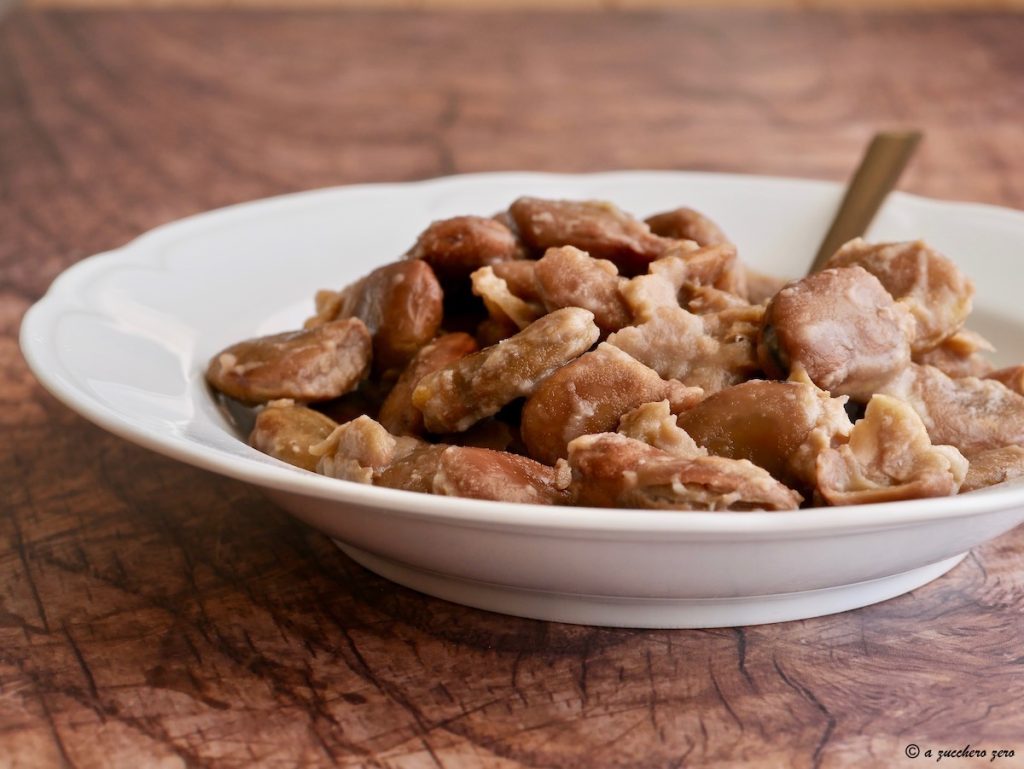
Cooked shelled fava beans and fava puree tend to thicken as they cool.
To bring them back to the right consistency, add about 1/2 cup (100 ml) of water and bring to a boil again.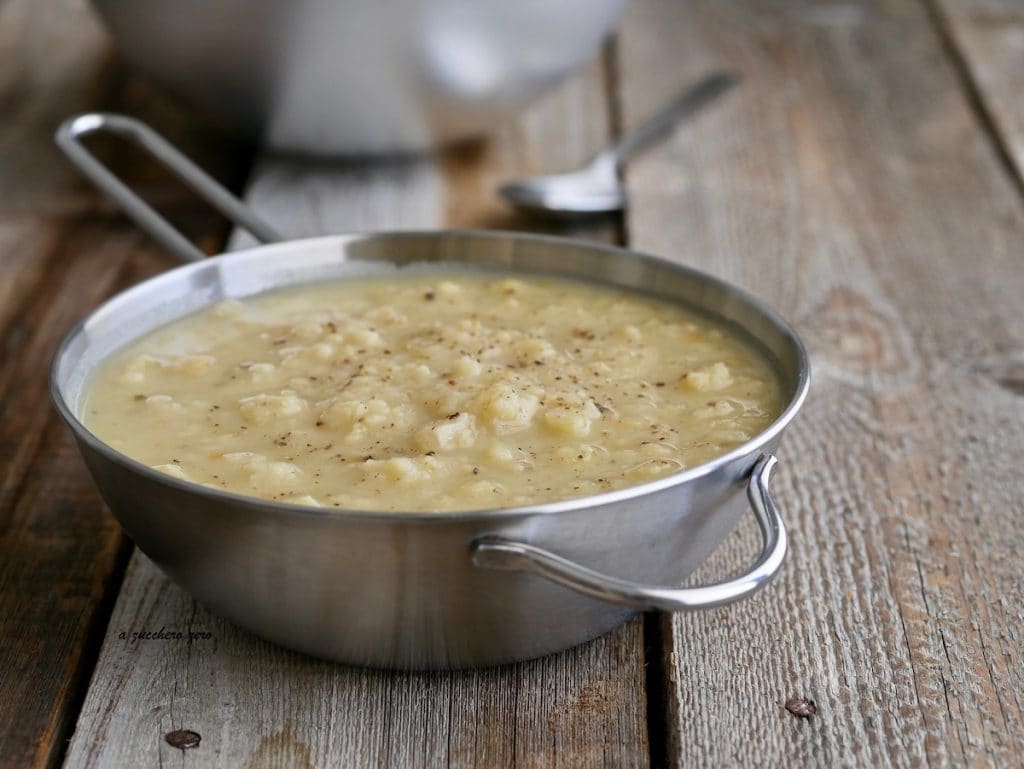
Storage, tips and variations
Storage
Store cooked fava beans in airtight containers:
– in the fridge up to 3-4 days;
– in the freezer up to 3 months.
Fava beans with skin
It is advisable to drain the legumes before freezing: nutrient loss is minimal but in the context of freezer storage it is a useful choice:
– better preservation without ice crystals;
– faster thawing;
– versatility: drained legumes are more practical to use in different recipes.
The amount of nutrients lost is minimal: most of the nutrients remain in the legume itself and many of these substances would degrade anyway during freezing and subsequent reheating.
Let the legumes cool completely, drain them and portion them.
If you want to recover everything, you can use the cooking liquid immediately or freeze it separately.
When you thaw them, you can replenish the liquid by adding water or vegetable broth.
If you plan to use them in brothy dishes such as soups or purées you can freeze them with some of their cooking liquid, making sure the container is suitable and leaving space for expansion.
Shelled fava beans
Let the shelled fava beans cool completely and portion them.
Tips and variations
As this is a base recipe I cook the fava beans simply.
Shelled fava beans are usually broken, which allows faster cooking and makes them ideal for preparing the Sicilian “macco” of fava beans.
If you like, you can add wild fennel.
With the heat turned off add a sprig of rosemary and a few sage leaves.
FAQ – Questions and Answers
FAVA BEANS AND DIABETES
Glycemic index of fava beans: GI 40.
The glycemic index of fava beans is higher compared to other legumes, and it increases with cooking.
– Can I eat fava beans? This is a question you should ask your diabetologist.
– Can people with diabetes eat fava beans? Follow your meal plan; ours includes them.
Usually, in cases of hyperglycemia, prediabetes and diabetes cooked fava beans can be consumed without exceeding portion sizes.Tips on how to combine legumes
In brief:
– legumes + cereals [bread, pasta or rice preferably whole grain] = correct combination;
– legumes + proteins = correct combination.
To deepen the topic read the article by clicking the following link: combining legumes in the diet.
In the case of brothy first courses, to avoid glycemic spikes, it is advisable to cook the pasta separately then rinse it and add it to the prepared brothy sauce; in this way the starch released by the pasta into the cooking water is removed.How can I be sure the legumes are of Italian origin?
Legumes are often grown abroad and packaged in Italy.
Carefully check that the packaging indicates:
Origin: Italy; Grown in Italy; 100% Italian product.
The wording “EU” or “non-EU” means they come from different countries such as Canada.
Shelled fava beans mainly come from Italian cultivations, with a strong concentration in southern regions such as Sicily, Puglia, Basilicata, Campania and Lazio.