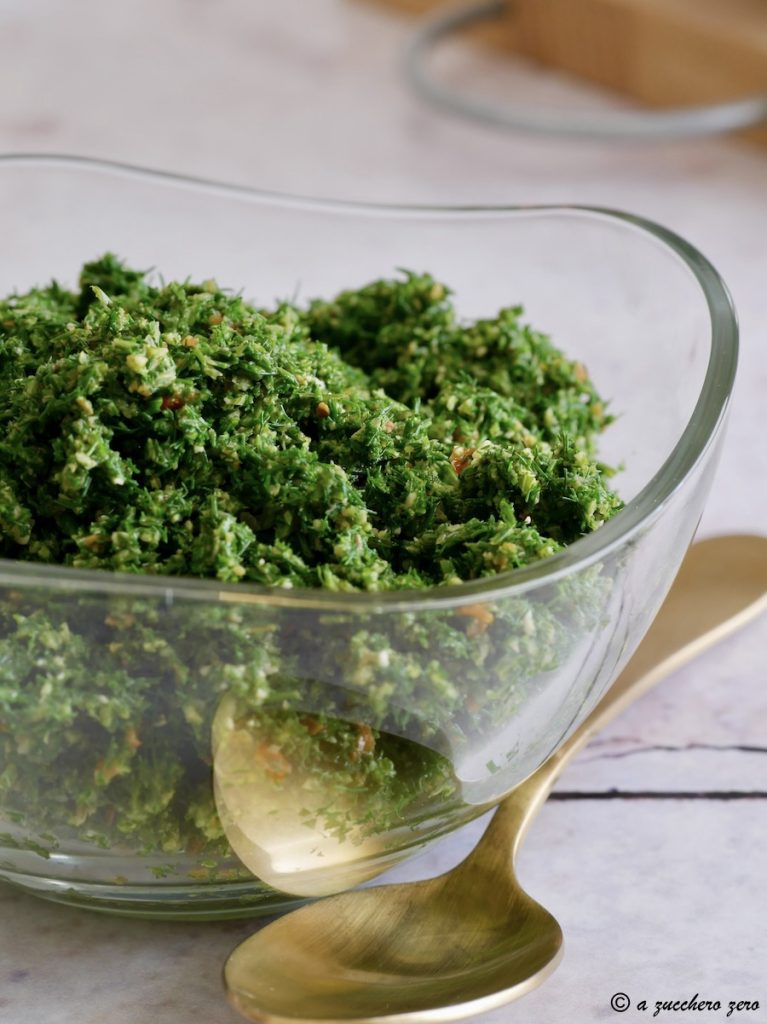
The light wild fennel pesto is an aromatic, tasty and light condiment perfect for flavoring many dishes.
Prepared with a small amount of oil, it has a coarse, grainy texture and retains a good portion of the wild fennel’s fiber.
Without garlic and without cheese, it is easy to digest and also suitable for those with intolerances.
It can be stored in the freezer and is a practical solution to always have on hand.
You might be interested in:
- Difficulty: Easy
- Cost: Affordable
- Preparation time: 20 Minutes
- Cooking time: 3 Minutes
- Cooking methods: Boiling
- Cuisine: Regional Italian
- Region: Sicily
Ingredients
- 3.5 oz wild fennel (fronds) (blanched)
- 6 dried cherry tomatoes (if packed in oil, well drained)
- 2 anchovies in oil (well drained)
- 2 tbsp pine nuts
- 1 pinch salt (if you do not add the anchovies)
- 1 pinch mixed peppercorns (whole, with grinder)
- 1 drizzle extra virgin olive oil (to finish (raw))
Suggested tools
- Knife
- Cutting board
- Chopper or Blender
- Molds for ice cubes
Preparation
Clean the wild fennel by selecting the tops, leaves and the most tender part of the stalk.
Wash thoroughly under running water.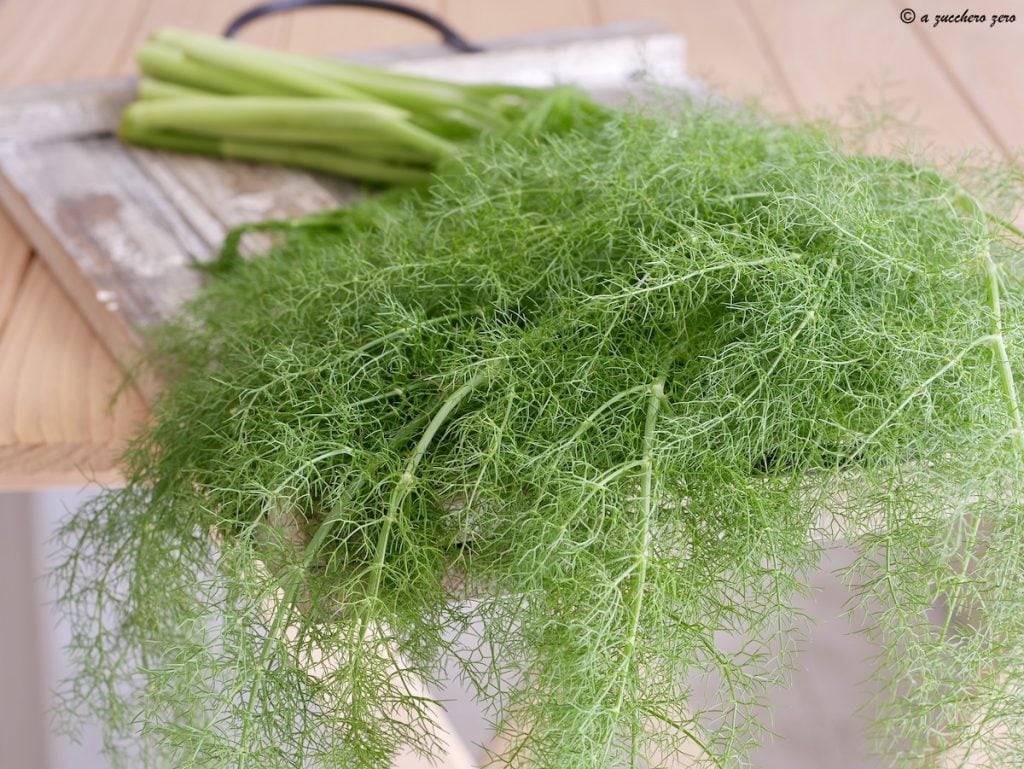
Bring a pot of water to a boil.
Add the wild fennel and blanch for 2–3 minutes.
Transfer it to a colander, cool it under running water and let it drain well.
Wrap it in a cloth and let it dry completely.
When it is well dried, separate the fronds and cut the stalks into pieces.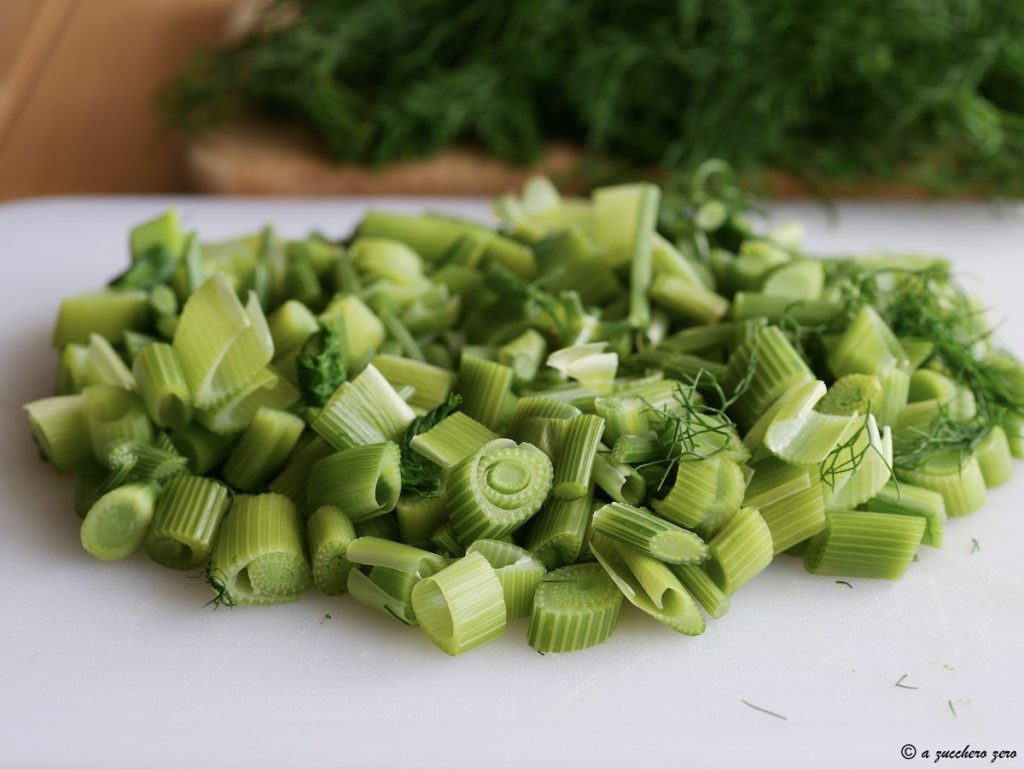
Dried cherry tomatoes
Drain the dried cherry tomatoes well and dry them on kitchen paper.
I use dried tomatoes that have been stored in the freezer, dry and without seasoning.Anchovies
Drain the anchovies well and pat them dry on kitchen paper.Pine nuts
Prepare 2 tablespoons of pine nuts.
To make a pesto that is not too caloric, the amount of pine nuts should be reduced: note that 30 g (about 1.1 oz, roughly 3 3/4 tbsp) cover the recommended daily portion.Put into the food processor:
– 3.5 oz blanched wild fennel;
– the dried cherry tomatoes;
– the anchovies;
– the pine nuts;
– a pinch of salt [if you do not add the anchovies];
– a pinch of pepper;
– a drizzle of extra virgin olive oil;
and chop.
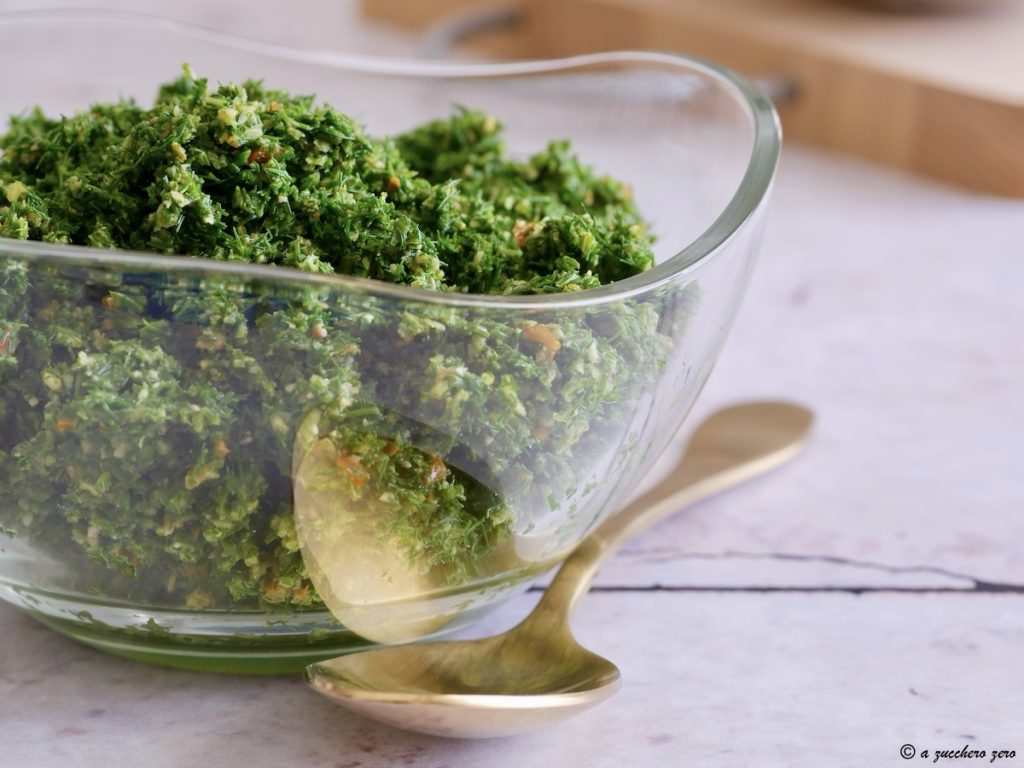
When preparing the pesto, pulse the food processor in short bursts rather than running it continuously, and avoid overheating the blades.With these quantities you will get a coarse, grainy texture.
For a smoother, creamier consistency:
– slightly increase the amount of extra virgin olive oil.Your light wild fennel pesto is ready.
Enjoy!
Wild fennel is a natural flavoring agent:
– it has an intense, recognizable aroma;
– only a small amount is needed.Use it to prepare:
– starters, first courses and main courses.How to use light wild fennel pesto in the kitchen
– to dress pasta [for a creamier version add a tablespoon of hot water or some tomato sauce];
– to flavor legumes, soups and stews;
– to season meat and fish;
– in salads;
– to prepare sauces, dressings and condiments based on vegetables, legumes, meat and fish.
Storage, tips and variations
Storage
Wild fennel pesto keeps in the refrigerator for 1–2 days in an airtight container.
Cover the surface with a drizzle of oil to slow oxidation.
Wild fennel pesto keeps in the freezer for up to 3–4 months while retaining aroma and fragrance.
It is advisable to freeze it immediately after preparation:
– in 100 g glass jars with lids for dressing;
– in ice cube molds to flavor dishes or to use as single portions.
Divide the pesto into containers and let it rest for about ten minutes so that the oil begins to rise; add a few more drops of oil to the surface of each container – jars and individual cubes – before storing or freezing to help preserve it better.
If you use it as a dressing you can let it soften in the fridge.
If you use it for flavoring you can add it frozen.
Tips and variations
Products preserved in oil (dried cherry tomatoes and anchovies), oil and pine nuts are all sources of fat.
For this reason it is important to use them in moderation.
The quantities used in this recipe are small and distributed among servings.
For a milder flavor reduce or omit the anchovies and add a pinch of salt to compensate.
You can replace pine nuts with other nuts (cashews, almonds, walnuts) or with sunflower seeds.
FAQ – Questions and Answers
Where does wild fennel grow?
Wild fennel grows spontaneously in the Mediterranean area.
It develops in uncultivated fields, along walls and along paths.When is wild fennel harvested?
It is harvested in spring, when the leaves are more tender.
However, wild fennel can also be found at supermarkets or specialty retailers, already cleaned and ready to use, at different times of the year.Can I use wild fennel raw?
It is better to blanch it.
Can I skip the anchovies?
Yes, add a pinch of salt to compensate.
Can I make the pesto without nuts?
Yes, the result will be less creamy.
Does the pesto change color?
The pesto tends to darken if exposed to air.
To keep it bright green:
– use dry wild fennel;
– avoid overheating the blades of the food processor;
– add a drizzle of oil on the surface after portioning it.