
The Casatiello in Naples is surely the undisputed king of the table during Easter. It’s that dish that, if missing, then it’s really not a celebration!!! Tradition has it that you begin preparing it on Good Friday to be eaten on Sunday, along with the lunch starters, and then it becomes the star of the typical Easter Monday (Pasquetta) picnics.
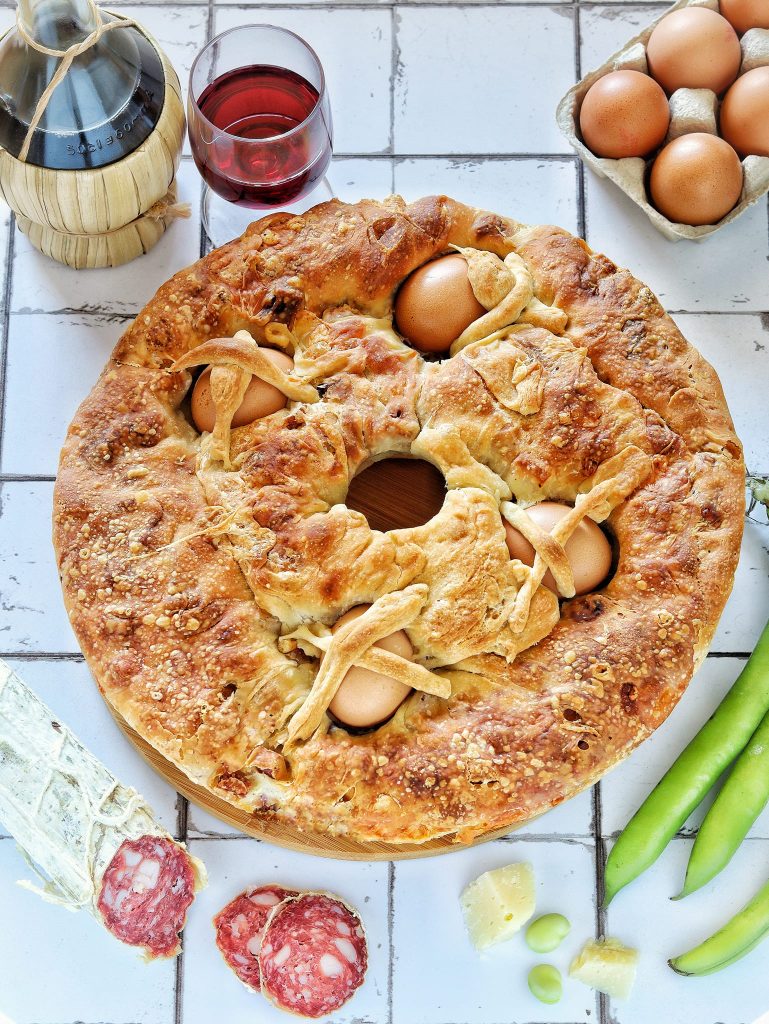
What makes this savory distinctive, besides the filling of cured meats and cheeses, is the use of lard (the strutto) which is used both in the dough and when stuffing the casatiello. Another characteristic element is the presence of whole eggs, placed raw on the surface and held in place by two strips of dough arranged to form a cross.
It is precisely in the eggs and the dough crosses that we find Easter symbols: the cross represents Christ and the egg is a symbol of rebirth.
Even the very shape of the casatiello is symbolic and recalls the crown of thorns placed on Jesus’ head during his calvary. My casatiello recipe foresees rather long proofing times (24 hours) but, I assure you, the satisfaction when you taste it will be directly proportional to the time spent preparing it.
Now take a minute to read the recipe and then…let’s COOK and EAT!!
- Difficulty: Medium
- Cost: Moderate
- Rest time: 24 Minutes
- Preparation time: 30 Minutes
- Cooking time: 50 Minutes
- Portions: 8
- Cooking methods: Oven
- Cuisine: Italian
Ingredients for a 12-inch pan
- 3 1/4 cups 00 flour
- 2 1/2 cups Manitoba (strong) flour
- 2 cups water (at room temperature)
- 1 1/2 tsp fresh brewer's yeast (about 5 g)
- 6 tbsp lard
- 1 tbsp salt
- 1 lb 2 oz mixed cured meats, diced (salami, pancetta, capocollo, ham)
- 9 oz provolone (mild, diced)
- 1/2 cup Parmigiano (grated)
- 1/2 cup Pecorino (grated)
- to taste black pepper (ground)
- 10 1/2 tbsp lard (at room temperature)
- 4 eggs
Tools
- 2 Bowls
- 1 Rolling Pin
- 1 Bundt Pan
Steps
To prepare the casatiello, start by mixing the two flours in a bowl.
In a second bowl, gather the water, dissolve the brewer’s yeast in it, then begin to pour the flour mix in a sprinkle, little by little.
In this first phase a simple fork will be enough to start mixing.
When you have added half of the flour and the dough is still fairly liquid, add the salt and stir. Then add the remaining flour and the lard. Continue working the dough with the fork until this operation becomes easy, then transfer to a work surface and knead the dough by hand until it becomes smooth and homogeneous.
At this point put the dough back into the bowl, cover with plastic wrap and let it rise at room temperature for 2 hours, then transfer everything to the refrigerator for about 10 hours.
Meanwhile, prepare the filling by cutting the cured meats and cheese into cubes.
After the hours of rest in the fridge, let the dough warm for 20 minutes at room temperature then, with the help of a rolling pin, roll out a sheet a few millimeters thick and cover the “pettola” (the rectangle of dough) with the lard, a sprinkle of the grated cheese mix and ground black pepper.
Now proceed with the filling by distributing the mix of diced cured meats and cheese evenly over the rectangle of dough.
Then roll it up starting from the long side and, as you roll, spread a light layer of lard over the roll you are forming.
Remove the two ends of the roll (they are usually leaner in filling; set the dough aside) and close it to form a ring.
Place your casatiello in the greased pan with lard, arrange the eggs on its surface and secure each of them with two strips of excess dough.
Transfer the casatiello into the turned-off oven and let it rise for 12 hours.
I recommend monitoring the rise to prevent the dough from overflowing the pan in case the ambient temperature is higher than expected.
Bake the casatiello in a static (conventional) oven preheated to 374°F for 45-50 minutes.
Continue baking for a few more minutes if you notice the surface is not completely golden.
You can eat the casatiello hot or cold, but in any case it is a must to accompany it with a good glass of red wine and some fresh fava beans 😉.
Storage
The casatiello keeps for 2-3 days at room temperature. Wrap it in plastic wrap or in a clean tea towel. Store it in a cool, dry place away from heat sources.
You can also store it in the refrigerator for up to 4-5 days, but it tends to become firmer. Before eating, warm it slightly in the oven (302–320°F for 10-15 minutes) to bring back softness.
FAQ (Questions and Answers)
Why let the casatiello rise for 24 hours?
Long fermentation makes the dough more digestible, develops flavors better and gives a softer, more open crumb structure.
Where should the dough proof during the 24 hours?
You can let it rise in the refrigerator (slow fermentation) or at room temperature for part of the time and then in the fridge, depending on the house temperature.
Can I reduce the fermentation times?
Yes, but in that case it is advisable to increase the amount of yeast.
Is it better to use fresh or dry yeast?
Both work fine. If you use dry yeast, reduce the quantity (about 1/3 of the fresh amount).
How can I tell if the dough has risen enough?
It should be puffy and soft. If you press with a finger, the indentation should slowly spring back.
Can I make the dough in the evening for the next day?
Yes, that’s ideal: mix in the evening, let it mature all night and complete the preparation the next day.
How to prevent the dough from collapsing after 24 hours?
Don’t overdo the time at room temperature and use little yeast. The refrigerator helps control fermentation.
