
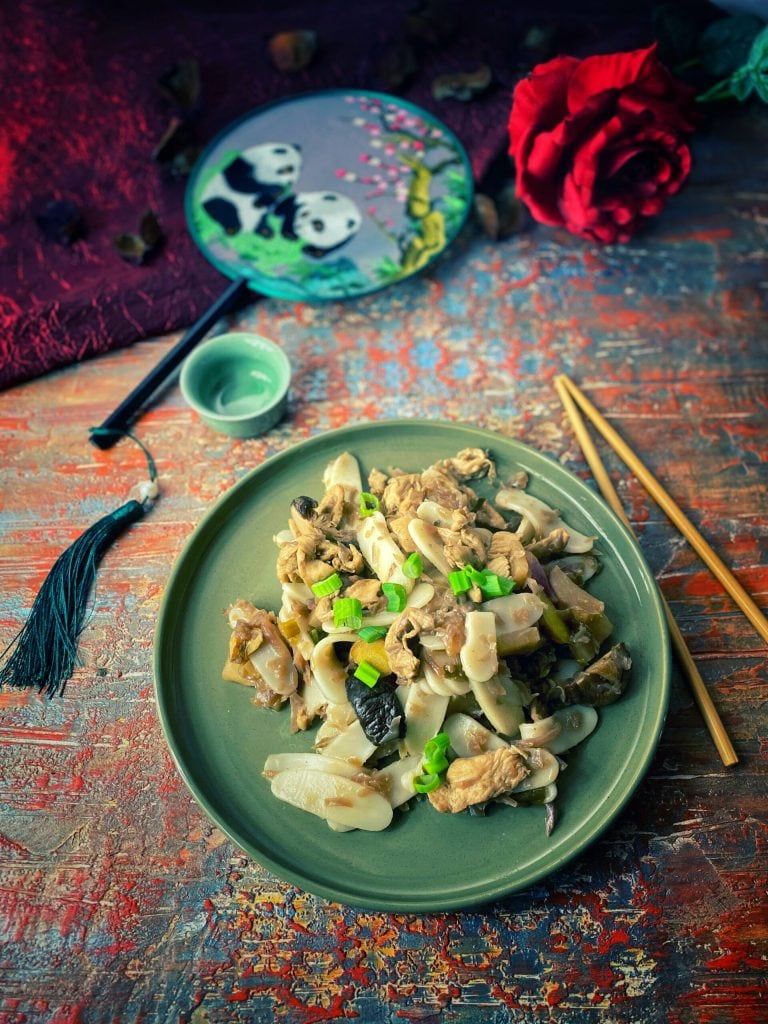
The chǎo nián gāo 炒年糕, are pan-fried rice cakes typical of Shanghai.
Shanghai nian gao is better known as rice gnocchi and should not be confused with Nian gao – the New Year rice cake.
The Shanghai version is made with non-glutinous rice and remains white in color; this latter characteristic is considered distinctive.
The rice gnocchi are stir-fried with qing cai, Chinese green cabbage, and a sweet-salty sauce made of soy sauce and sugar.
The most common method to cook nian gao is to stir-fry it, after which the dish name becomes chǎo nián gāo (炒年糕), from chǎo meaning “pan-fried”.
There are three different types of chǎo nián gāo: the first – the recipe below – is a savory dish, to which various meats (beef, pork, or chicken) and vegetables (cabbage or celery) are added.
The second version is sweet, sweetened with regular white sugar, while the last version is plain, often eaten for its pleasant chewy texture.
Chinese Nian gao have a sticky, chewy texture.
The origin story may date back 2,500 years to Suzhou during a chaotic war period (722-481 B.C.), but it was during the Ming and Qing dynasties that nian gao became a staple food, with different varieties developed in the north and south.
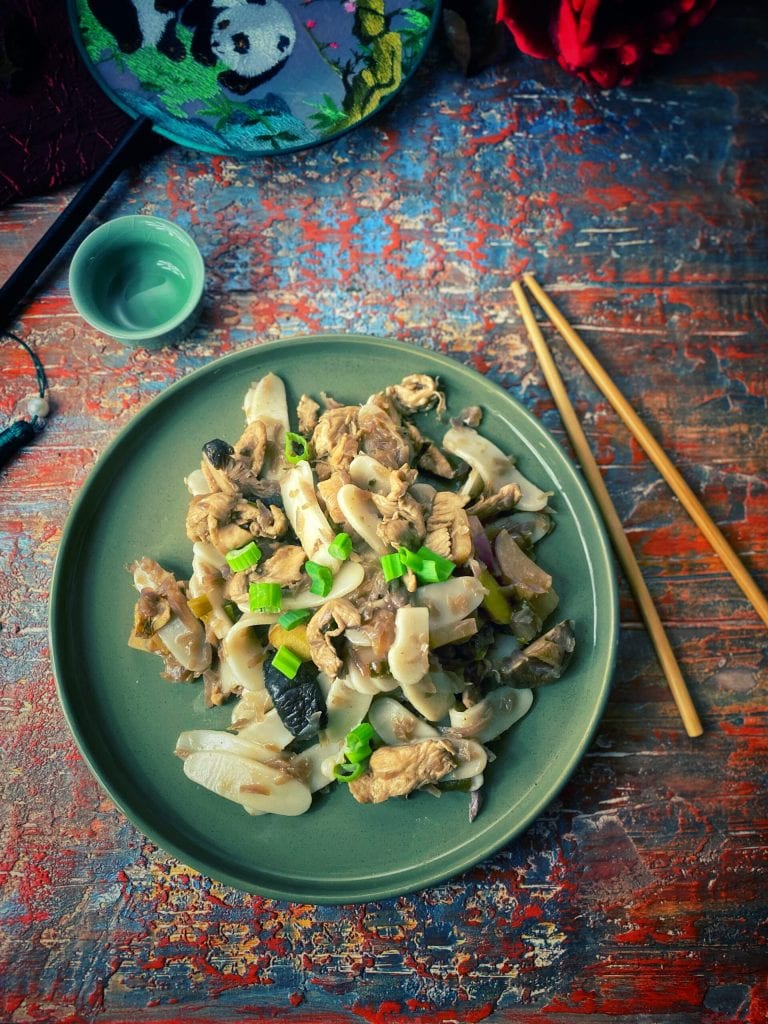
My version, for the recipe below, uses chicken, shiitake mushrooms, white radish, purple cabbage and scallion.
- Difficulty: Easy
- Cost: Budget
- Rest time: 12 Hours
- Preparation time: 10 Minutes
- Cooking time: 10 Minutes
- Portions: 4 people
- Cooking methods: Stovetop
- Cuisine: Chinese
- Seasonality: All seasons
Ingredients
- 14 oz Chinese rice gnocchi
- 4 shiitake mushrooms (dried or fresh)
- 8 oz chicken breast
- 7 tbsp soy sauce
- to taste white pepper
- 1 tsp sugar
- to taste sesame oil
- to taste fresh ginger (thinly sliced)
- 2 cloves garlic
- 1 stalk scallion (green onion)
- 1/2 head purple cabbage
- 1 white radish (daikon)
Tools
- 1 Wok
Steps
If you don’t want to buy them ready-made you can follow this procedure for making rice gnocchi:
In a large bowl, sift glutinous rice flour and rice flour.
Gradually add water and knead until you form a pliable dough.
If it becomes too dry, add water, one tablespoon at a time.
If too wet, add glutinous rice flour tablespoon by tablespoon.
Form balls of dough weighing about 1.5 oz (40 g).
Cook in boiling water for 3-4 minutes or until the dough floats to the surface.
Shape into flattened ovals and steam for 25 minutes.
If you purchased the gnocchi ready-made, soak them in water overnight to soften.
Soak shiitake mushrooms in hot water for 15 minutes, drain but keep the soaking water, and slice the mushrooms.
Marinate the chicken cut into strips for one hour with 3 tbsp soy sauce, white pepper and 1 tsp sesame oil.
Prepare the sauce by mixing 4 tbsp soy sauce with the sugar.
Heat 2 tbsp oil in a wok, add the ginger, garlic cloves, sliced chili, thinly sliced purple cabbage, the whole sliced scallion including the green part, the cut radish, the mushrooms, the chicken and stir-fry for a final minute.
Immerse the nian gao in boiling water for 5 minutes.
Add the nian gao and mix well, scraping the bottom of the wok for 30 seconds, then cover for one minute.
Uncover and add the sauce and the mushroom soaking water.
Mix well and stir-fry until the rice gnocchi are cooked but still chewy.
FAQ (Questions & Answers)
What is the difference between nian gao and Korean tteokbokki?
Unlike the Chinese version which is flat, the tteok is cylindrical in shape and has a significantly chewier bite compared to its Chinese counterpart.
Tteokbokki are boiled and coated with a red sauce made from gochujang (chili paste), gochugaru (chili flakes), soy sauce, sugar and sesame seeds.
Unlike the Chinese version which is sliced and flat, the tteok is long and cylindrical and has a significantly chewier bite compared to the Chinese counterpart.
A Korean dish similar to Chinese nian gao is Gungjung Tteokbokki, or royal court rice cakes. As the name suggests, the traditional dish dates back to the Joseon dynasty and, in contrast with the modern spicy version commonly found at street stalls, Gungjung Tteokbokki is stir-fried with sliced meat, vegetables and a delicate soy-based sauce.
