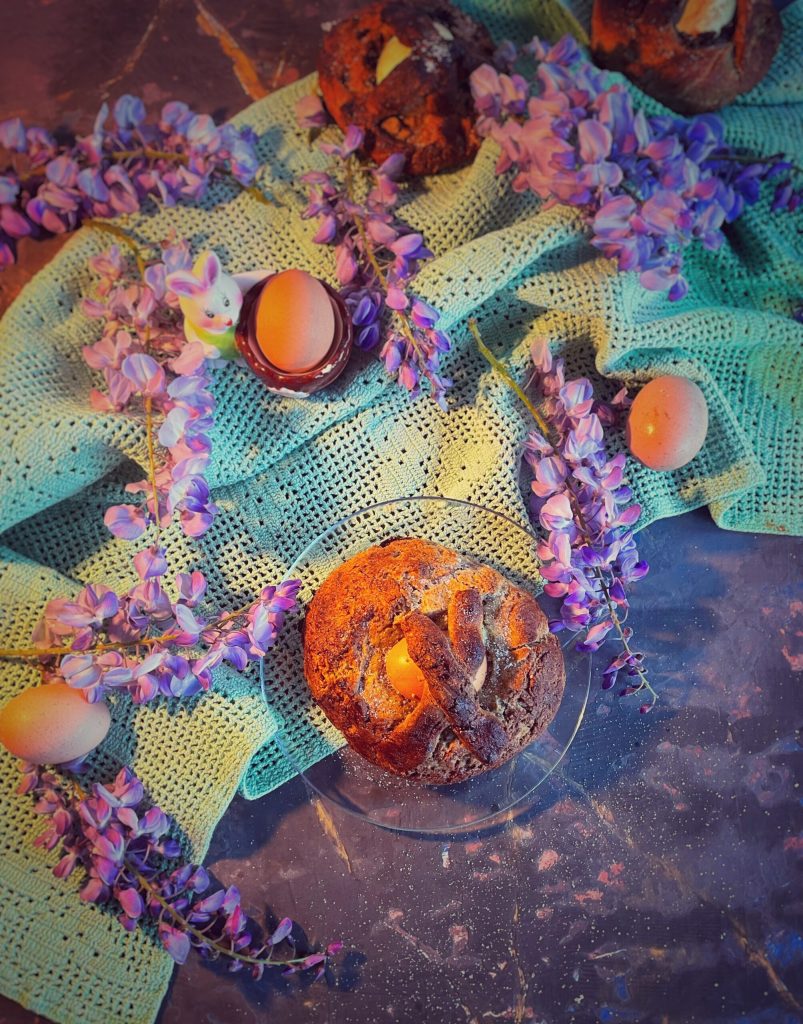
The Mona de Pascua is the traditional Easter dessert in Spain, especially in the regions of Valencia, Murcia and Catalonia.
Its name has ancient roots: it probably derives from the Arabic term munna, which means “gift” or “provision for the mouth”. In antiquity it was a tribute of food (eggs, sweets, agricultural products) that the Moors offered to their lords as a wish for fertility and abundance.
The inclusion of hard-boiled eggs became central with Christianity: the egg represented life being born and the Resurrection of Christ.
Originally, the Mona was a simple sweet bread, enriched with hard-boiled eggs, that godfathers gave to their godchildren on Easter Monday as a wish for fertility and rebirth. The cake contained as many eggs as the child’s age, up to a maximum of 12 (the typical age for Confirmation).
This tradition still lives on today in outdoor picnics, where “breaking the egg” of the Mona is a festive gesture that brings generations together.
If the shape closely recalls our cuzzupe from Calabria or the Puglia scarcelle, the Spanish version stands out for its distinctive aromas: the intense perfume of orange blossom water (agua de azahar) and the use of olive oil instead of butter.
Today in Spain, Lunes de Pascua is the day when families go to the countryside to “break the egg” (cascar el huevo) on a friend’s forehead (as a joke) and eat the Mona together.
In this recipe I wanted to reinterpret this centuries-old tradition to make it accessible to everyone without betraying its soul.
I present a Gluten-Free Mona de Pascua, made with Sourdough Starter for improved digestibility and lasting fragrance.
- Difficulty: Medium
- Cost: Budget-friendly
- Rest time: 13 Hours
- Preparation time: 15 Minutes
- Cooking time: 30 Minutes
- Portions: 4 pieces
- Cooking methods: Oven, Electric oven
- Cuisine: Spanish
- Seasonality: Easter, Spring
Ingredients
- 5.3 oz fresh gluten-free sourdough starter (refreshed)
- 3.4 fl oz milk (about 7 tbsp)
- 1/2 cup sugar (+ for decorating)
- 3 2/3 cups gluten-free flour mix
- 3 tsp xanthan gum
- 1 tbsp orange blossom (orange flower) water
- to taste lemon zest
- 2 eggs (+ 1 for brushing)
- 5 1/2 tbsp olive oil
- 4 hard-boiled eggs
- 1
Steps
Activation: In a large bowl, dissolve the sourdough starter in warm milk with the sugar and the orange blossom water.
Dough: Add the 2 eggs and the olive oil. Start incorporating the flour sifted with the xanthan gum and the citrus zests. Work the dough (preferably with a stand mixer) for about 10 minutes. It should be elastic and slightly sticky. If it is too dry, add one tablespoon of milk.
First Rise: Cover the bowl with plastic wrap and let it rise in a warm place (79–82°F) until doubled. With sourdough starter it will take about 6 to 10 hours.
Shaping: Divide the dough into 4 round balls (the classic monas).
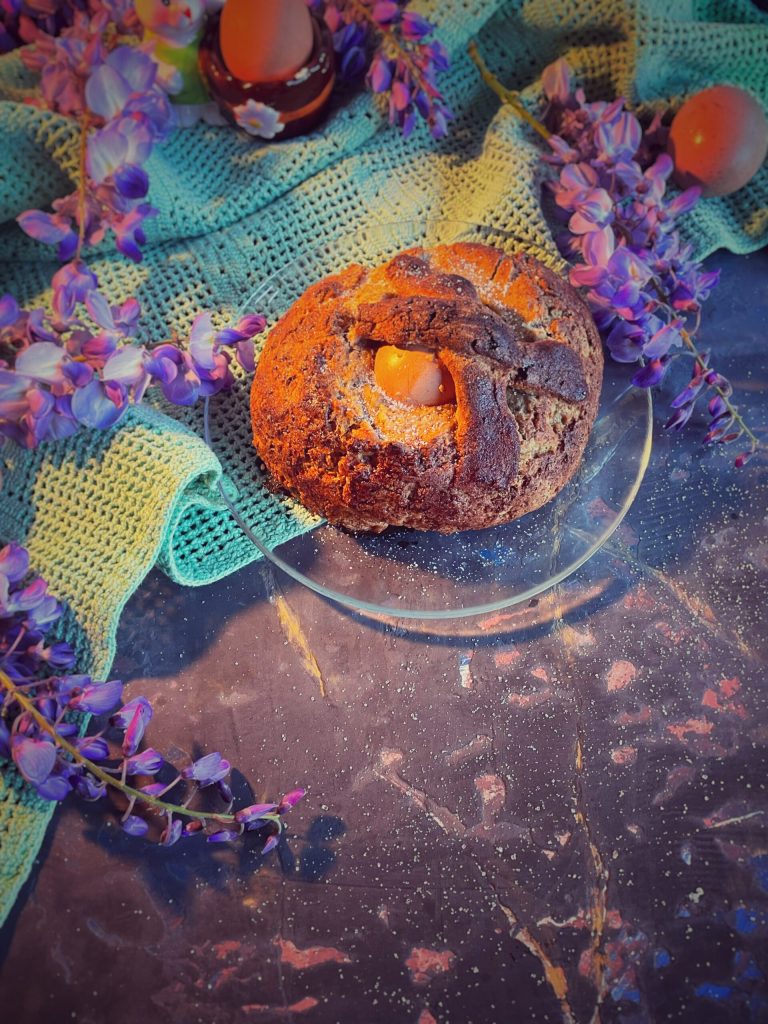
Flatten the center of each ball slightly and place the hard-boiled egg (with shell — you can also color the shell beforehand) brushed with oil.
Create two strips of dough and cross them in a “X” over the egg to secure it.Second Rise: Place the monas on a baking sheet lined with parchment paper, cover them and let them rest for another 2–3 hours.
Baking: Brush with the beaten egg and sprinkle generously with sugar. It is typical to moisten a little granulated sugar (azúcar humedecido) with a few drops of water to form white “lumps” to place on top before baking: they create that sugary crust typical of the Valencian version.
Bake at 338°F (convection) for about 25–30 minutes, until golden.